On Teaching Writing

2

Cindy's avatarThe Writing Pool

We’re just over a week into the new year and what a busy week it was! My two short story writing classes began and I only hope my students are enjoying it as much as I am. One of my students asked if I planned to read and comment on everything they submit. I can’t imagine being a writing teacher and not read what my students write, at the very least. And because I’m teaching the course, I can’t not comment on whatever they submit. It is a writing class, after all, not a lecture class. I always believe that people learn best by doing and, if there’s a teacher available, it’s that teacher’s responsibility to provide whatever guidance can be given. I’ve always been a very involved teacher, and teaching how to write requires a great deal more involvement than, maybe, teaching literature, which I also love, by the…

View original post 142 more words

On Writing: Dealing with Adverbs

0

The road to hell is paved with adverbs.

~Stephen King

Quite recently in the world of writing, adverbs have been shunned, probably because of what Stephen King wrote in his iconic book On Writing, which provides writers with a great deal of advice on how to improve writing with his unique writing style and perspective. This really isn’t anything new. Ever since the very fist edition of Strunk & White’s Elements of Style was published in 1959, writing teachers have tried to impress on students of writing the concept of “less is more.” That King specifically cites adverbs has everyone jumping the bandwagon and cutting out any word ending in –ly from their works. I’d say that’s really a rash reaction, because adverbs are beautiful words that help the reader create an image in their mind. What writers need to remember is that there are different kinds of adverbs, and some are worse than others, insofar as leading a writer down the road to hell. The use of adverbs is closely linked with the need for writers to “show, not tell,” a skill that is more difficult to master than many writers think. Because adverbs, especially adverbs of manner, tell us how verbs act. For example, we say “He ran quickly” using the adverb “quickly” to describe how he ran. In this example, I’d say the use of the adverb ‘quickly’ is lazy, just because there are so many ways to describe running. The preferred and more effective option is to use the exact word, and in this case, ‘ran’ is not exact enough. To show how a person runs quickly, we can more effectively use the words raced, rushed, dashed, hurried—you get the idea. Choosing the more exact word is using more picturesque language with less words. Alternately, you can say “His legs pumped up and down as he pounded the ground with his feet, his face drenched with sweat pouring from his brow with the effort, touching all he passed with a rush of warm air.”

On the other hand, there are adverbs that have no better way of being said, such as adverbs of time and place. There’s no better way to say “today” than with the word ‘today’; there’s no easier way to say ‘up’ or ‘down’ than by using the adverbs exactly as they are. When using linking adverbs, you need to make sure they are necessary. Linking adverbs help describe sequence (then), cause and effect (consequently), and contrast (however) and give us better transition between ideas, phrases, and sentences. Be careful not to overuse linking adverbs, though. I advise against the use of evaluative adverbs in writing fiction because it introduces too much of the author’s opinion into the text; use evaluative adverbs only when they reflect a specific character’s thoughts. Authors need to be very careful not to be actively present in their stories, and leave the stories to the characters and their narrator. Even if you use the omniscient narrator, who sees and knows everything, you must be careful to maintain your narrator’s persona. If you want to write your personal opinions, then write creative nonfiction. Unless you want to sound like today’s younger speakers, be careful how you use degree adverbs—adverbs that show to what extent or degree something happens. Modern language has seen the introduction of some words to replace the word ‘much’ so instead of saying ‘much more’ or ‘much less’ we hear people saying ‘way more’ or ‘way less’ and so on. Unless your character has a terribly limited vocabulary, I’d limit the use of this colloquialism. Focusing adverbs can also be dispensed with most of the time because they tell the reader what to think, rather than show them things, and are generally a matter of opinion (in the same way I used the word ‘generally’ in this sentence).

All this is not to say that we shouldn’t use adverbs at all. Adverbs can be very effective when used judiciously. Sometimes, there isn’t enough time to ‘show’ the reader everything in full picturesque detail because sometimes the details are not that important. In that case, you can either use the adverb or eliminate the details, because they probably aren’t significant enough to include.

2015 in review

0

Thanks to everyone who dropped by in 2015! Looking forward to seeing more of you in 2016!

The WordPress.com stats helper monkeys prepared a 2015 annual report for this blog.

Here’s an excerpt:

A San Francisco cable car holds 60 people. This blog was viewed about 2,200 times in 2015. If it were a cable car, it would take about 37 trips to carry that many people.

Click here to see the complete report.

To my son, Justin, on his 20th birthday

0
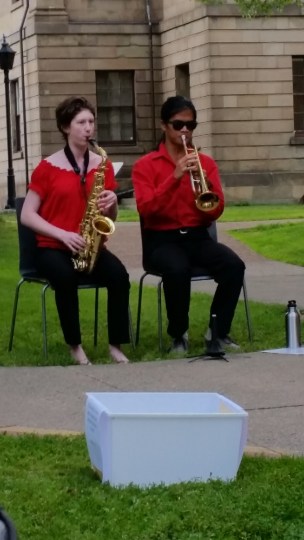
20150806_181344

Justin Lapeña Amador on the trumpet, at the performance of “Blindness: A Dark Comedy” (2015)

And so today has come around and once more, I wish my youngest son, Justin Lapeña Amador a Happy Birthday, wherever you are, whatever you are doing, no matter what you think, believe, or think you believe. I still fervently hope for the day when you start to think on your own, without your father influencing your thoughts; when you start to question what you blindly believe in because your father told you so; when you realize that you are NOT your father and do not need to agree with everything your father says or does, no matter how misguided or wrong. Today, you are 20. Today, you are no longer a teenager, no longer a child. I always pray and hope that you are on your way to becoming a loving, caring, sensitive, thoughtful man; generous to a fault, selfless, kind, helpful, honest, trustworthy, persistent–everything I tried to instill in you in the 13 short years I shared with you; everything you could not learn from a man who does not have any of those traits–but that is for you to discover, admit, and believe in. I wait for the day you choose to remove the blinders he has kept you in. I wait for the day you choose to see beyond the last 7 long years, extremely painful for me. I wait for the day you realize everything your father was and did that caused me grief when he began making you think the way you now do when you were but 6 years old. I wait for the day you realize that I never chose to leave you, but that because I chose not to return to him, his influence over you took full hold. So many things I wait for. So many things I wish for. So many things I cannot change and cannot explain because until you are your own man, you will not understand. Not the pain, not the angst, not the worry, the indignity, the suffering of all your father has caused me.

Whatever your choices now, there is nothing I can do until you take those steps that will help you realize and understand everything I have done for you. What kind of man will you be, Justin Lapeña Amador? What kind of son do you choose to be? What kind of professional, friend, partner, lover, and above all, human being do you choose to be? Your past is not something you can deny, nor is it something you can change. But you can make the future better if you learn to acknowledge and understand your past.

I cannot keep on refusing myself happiness, peace, transition, transformation. But I cannot think for you or decide for you. And neither should you allow your thoughts, beliefs, actions, and decisions be influenced by your father. The ball is in your court. Much as it pains me, I will no longer inflict more pain on myself by trying to reach out to you.

Happy birthday and good luck.


How to Create Memorable Characters

3
[I]t’s not a good idea to try to put your wife into a novel. Not your latest wife, anyway.

~Norman Mailer, quoted in Writers at Work: The Paris Review Interviews, Third Series, 1967


How are characters created? In non-fiction, characters are clearly real people as described by the writer. In fiction, however, characters are supposed to be completely fictitious, a.k.a., unreal, made-up, invented, created, imaginary. And yet, the best writers are the most notorious borrowers, copiers, and imitators, mainly of life. How else would they be able to create surrealistically real scenarios and characters if they did not borrow, copy, or imitate from real life? The best writers are excellent students of life in that they observe life keenly and everything they see becomes a potential source for something they write. They might describe a restaurant, but if they had never sat in a restaurant and observed every little detail about it, from the cutlery to the cuisine, from the service to the servers, from the entrance to the ambience, they would not be able to create a restaurant in words that places the reader exactly where the characters are. The same thing goes for characters. Writers need to observe people closely, watching every movement and pose, from the twitch of the fingers to the facial tics, from the strands of hair to the creases and folds of their clothes, from the twinkling in the eyes to the faintest blue or red capillaries weaving delicate networks on a papery-skinned cheek—such is what brings characters to life. As well, not a single little mannerism should escape them, from how a coffee mug is grasped to how hair is brushed from the face, or how fingers tap or twirl and feet jiggle to the slant of shoulders, the tilt of the head, the curvature of the spine, the way ankles or knees or arms cross—all these make characters more human. To complete that image, characters have voices, different tones, different expressions and ejaculations, different accents, different kinds of laughs. It’s not surprising, therefore, if a writer’s characters resemble the people around them, the people they live with, the people close to them, or even the people they detest and abhor the most. Of course, only those who know both the writer and the people in the writer’s life will know who a writer has modelled a character after. In fact, if you are a writer looking for a character, you need look no farther than your family, friends, and acquaintances. In most cases, writers will pick and blend characteristics so that their fictitious characters are a mish-mash of traits from several real people. Depending on how realistic the fiction is, writers can take all the good traits from several real people and put them in the protagonist, then take all the bad traits from those same people or others and put them in the antagonist. While that may not sound realistic, that would certainly make a great caricature for a cautionary tale, a humorous tale, or a fantasy. Certainly, the more unrealistic characters are, the more impossible it is that they are real people. Of course, that is not to say that there are real people out there who are real characters—which is where our expression comes from for calling people “characters”—the fact that they seem so unreal, it’s almost as if they’ve been made up.

When I give workshops that teach writers how to develop characters, I usually provide participants with a character sheet, not unlike character sheets you might find for role-playing games, because they are, essentially, character creation sheets. Writers can develop their own or look for them in a variety of online writing resources. Basically, a character sheet has three major aspects: (1) the physical features of the character; (2) the biographical-historical background, and (3) the emotional-psychological features of the character.

As the categories suggest, the physical features tell us how tall, heavy, the color and length of hair, the eye color and shape, the shape of the body, identifying marks, hand and foot size, what fingers and toes look like, clothing size, teeth condition, nose and nostril type, neck, etc. It helps to have a picture of someone real, or to create analogies: swan-like neck, flared nostrils, chunky fingers and toes, spade fingernails, etc.

When describing biographical-historical background, we decide how old the character is, birthdate, place of birth, race, nationality, residence, family, relatives, languages, education, skills, places lived, their work, religion, memberships, training, jobs held, and all other types of things you might find in the most comprehensive biodata and curriculum vitae ever.

Third, and probably the most difficult, is establishing the emotional-psychological profile of the character. This includes quirks, beliefs, superstitions, attitudes, intellect, viewpoint on various topics from politics to art and culture to family, personality type, phobias, preferences, desires, weaknesses, dreams, and anything else that reflects their psyches. Finally, every character must have that fatal or tragic flaw. That one thing that is the character’s Achilles heel, the one thing that will affect the character’s success. It can be one or more of the character’s phobias or weaknesses that prevent success, but definitely one thing that within the character that works against overcoming the problem they face in the story. This is the humanizing factor that makes readers more sympathetic towards fictional characters, because we all know that nobody is perfect.

While I have presented a great deal of details that can go into the creation of a character, that is not to say every single detail must be present. As an aid to determining how much detail to include when creating a character, let me just say that the detail should be commensurate to the length of the story. The shorter the story, the less detail; longer, epic stories will need greater detail, because then, characters are exposed to the reader’s scrutiny in a greater variety of situations. They meet more characters, do more things, have more to accomplish or overcome; hence, they need to be more well-thought out, more fleshed-out, more real to account for every possibility along the way. This also makes them more realistic and, ultimately, more sympathetic. Readers will admire heroes but they adore heroes who succeed despite their flaws. In fact, the more flawed the hero, the more sympathetic and, in the end, the more sweet the triumph.

I still want to get a shirt that says: “Beware. Novelist. I’m watching you. I just might write you into my next novel.” Novelists do write people they know into their novels, because it’s the people they know best who provide them with the best fodder to humanize a character. If you want to paint them as the antagonists, however, heed Norman Mailer’s advice: don’t make your characters too much like the people you live with, because then, you’d have to live with them and they’d never let you live it down. They can make your life unbearable, so be careful what you write about them or how you write them into your novel. Especially if it’s your spouse. Unless they don’t read your novels at all, then you’ll be perfectly fine. Still and all, I think it one of the most fun and entertaining things to do as a writer, to include bits and pieces of real people into my characters. I’m sure every great writer has picked traits from people they have encountered to make their characters more interesting and real. The trick is to change the physical characteristics and biography so the real people aren’t easily recognizable. Try it on some character sketches and have fun!


 

Eight Signs Aladdin is a Comedy

0

A review of Aladdin: A Fairly Tall Tale

By Cindy Lapeña

There are certain definite signs that a play at the Confederation Centre for the Arts Homburg Theatre is not a going to be a serious play. Let me elaborate. For the majority of performances, the first person you see or hear is Monique Lafontaine announcing the entrance of PEI’s very important members of the audience (VIMA, for those who haven’t met them) and the token reprise of O, Canada!, followed by her announcement of the theatre rules in English then French, before the lights dim and the first characters enter.

The first sign that this is not a serious play: When a story claims to be a “fairly tall tale” it’s a dead giveaway for humour with a capital H. This is all reminiscent of Mark Twain and his classical humorous short stories, better known as his ‘tall tales’. But this is PEI and the farther away from center you go, the taller the tales.

The second sign: When the program announces at the top of the cover that “This Christmas, Aladdin gets an Island twist!” Unless they meant a new kind of McCain’s French fry twists, this can only be interpreted as the somewhat quirky twisty sense of humour you get from being an Islander, or living on the island long enough to be almost indistinguishable from the rest.

The third sign: Highly unusual program content, such as Gordon Cobb on Aladdinthe cover with a silly face; Graham Putnam playing a suspiciously-named character called “Widow Twanky”, never before heard of in the fairy tale world; another suspiciously-named character named “Baron Wasteland” played by Dennis Trainor who sounds just like Bawwy Kwipky (from The Big Bang Theory); a cross-over character, Sarah Macphee as the Town Crier from last year’s Cinderella: A Fairly Tall Tale.

The fourth sign: Adam Brazier wrote the script and Scott Christian, who was the musical director, is working on his fourth panto. For those unfamiliar with this term, the panto is short for ‘pantomime’ but really isn’t one; it’s the 18th century British take of the traditional commedia dell’arte, and instead of the traditional Italian characters, they turned fairy tales into comical musical plays for Christmas. Knowing what kind of play it is pretty much explains it all, which makes this our ‘Ah, I see,” moment. But it doesn’t end there.

The fifth sign: Instead of Monique Lafontaine, as I mentioned in the opening paragraph, Adam Brazier walks onto the stage apron before the play begins and, like a TV show cue-master coaches the audience to “boo” or say “we love you Widow Twanky” at the appearance of certain characters, you know it’s a play made for kids and the young at heart, and it’s not going to be serious. Just how much?

The sixth sign: The evil Jafar with Rejean Cournoyer’s larger-than-life presence and distinctive rich booming bass-baritone voice uses a classic mwah-ha-ha laugh and interacts with the audience.

The seventh sign: The explosive and rib-cracking opening number is all about Vic Row in Downtown Charlottetown and Aladdin played by the boyishly charming Gabriel Antonacci is actually a Cinderella-boy.

The eighth sign: People can’t stop laughing when Graham Putnam is revealed as the hilarious Widow Twanky who has at least 3 jokes for every nugget of well-concealed wisdom. The Widow Twanky is also our source of adult humour, which, hopefully, none of the little kids in the audience understood.

I am going to stop at eight signs because if I keep on, then there would be too many spoilers to this insanely inane comedy that had me laughing so hard tears actually came to my eyes. Unfortunately, another spoiler alert I can’t help revealing is that the music is original, funny, and on the verge of copyright infringement—but if you listen to the dialogue and lyrics closely enough, they already know that.

There was really just one major spoiler to this panto and that was the problem with the mikes. I know miking for a huge cast in a musical play is difficult, to say the least, but the mikes were often out when they should have been on and it was very distracting for the voices to suddenly blare on mid-sentence or mid-word. Thank goodness, the audience was laughing most of the time they would have drowned out the dialogue anyway. Really. I miss those days when actors did not have to depend on microphones to be heard and that you really had to learn how to project your voice without losing it after the first show.

That said, everyone needs to catch this performance before it’s over, because it will certainly bring you cheer and laughter for the Christmas season.

###

How acceptable is verbing?

0

I am treading on shaky ground here, but as a writer and English teacher, it’s a topic I can’t ignore. There really isn’t any other word for it besides VERBING, which in itself, is turning a noun that isn’t used as a verb into a verb. That’s when nouns that do not have verb forms are used as verbs. One of the most common nouns that I have seen being used as a verb for quite a few years now is the word “gift”. People everywhere, including on the news, have been saying “gifted” not in the sense of the adjective that means “talented” but in the sense that means having been given something as a gift. For example, “He gifted her with a scarf.” What the heck was wrong with the verb “give” and all its tenses? “He gave her a scarf” means exactly the same thing. If you give someone something, it’s a gift. Take this other sentence: “It’s the season for gifting.” Whatever happened to the word “giving”? There was absolutely nothing wrong with the sentence “It’s the season for giving.”

Okay, I’ll look at it another way. You can say “giving” and come up with the image of someone passing out something–anything–to another person. When you say “gifting”, the image you come up with is someone handing a nicely wrapped present to someone else. Looking at it that way, I will very reluctantly admit that “gifting” suggests giving a present that’s prettily wrapped. It’s completely different from someone giving me a pair of scissors, giving me a piece of his mind, or giving me a disease. That said, I still can’t get myself to use “gift” as a verb.

Grammatically, many nouns have verb forms, and we don’t really give it a second thought. Some very few examples are research, produce, comment, fan, walk, sleep, cook, drink, etc. Nobody ever questions their dual functions as nouns and verbs. How did they ever gain that duality? I’m not going into that historical aspect of when they were first seen on record used as either noun or verb, although I’m sure there’s some linguistic study somewhere that does that.

That language is a dynamic form of communication is undeniable. If we still spoke English the way it was spoken during Chaucer’s time or Shakespeare’s time or even during the Victorian era, we would sound really strange–unless everyone still spoke exactly the same way. Grammar most likely was invented along with the standardization of everything else during the industrial era. People in control of things probably felt that they needed to standardize language so that it would be easier to understand across various borders, whether political, cultural, scientific, or even personal borders. Creating rules for how language should be structured and documenting those rules ensured clear understanding by the majority of people throughout the world. That standardization of language has given us a measure for deciding what is correct language or good writing. That said, language changes. It adapts to the times. New words are created and useless words become obsolete. This happens because of changes in lifestyles, in technology, thinking, and just about every area in life. A hundred years ago, the word ‘cellphone’ never existed; a little over a hundred years ago, the word ‘airplane’ did not exist; before it was ever invented, the word ‘laser’ was completely unknown. This list can go on and on. On the other hand, how many kids nowadays know what a ‘bustle’ is–and I don’t mean bustling about or hustle-and-bustle; how many people walk about carrying a ‘poke’ over their shoulder?; how many people keep an ‘inkhorn’ or use the word ‘ruth’ to mean the opposite of ‘ruthless’?; nobody calls a ‘thrift’ shop a ‘frippery’ anymore, nor does anybody say they’re having a ‘rejumble’ when they’re experiencing ‘acid reflux’.

Granted, many terms or words that are now obsolete are in  word museums because whatever they referred to is no longer in use, or a better, more scientific name has replaced it. Other words die because of political correctness, regardless of what they originally meant, and the extent of influence political correctness has on language nowadays is, I think, the far swing of the pendulum. But it is also that sensitivity, rational or not, that has given use new words or new meanings for words, such as ‘gay’.

If you were to ask me, I’d say use the words that are there. I think anyone who doesn’t even try to find the right word or the exact word, is just plain lazy. Even if you don’t know the word, there are all kinds of dictionaries and thesauri that you can refer to. Not having a computer isn’t even an excuse, because before online references, we had real ink-and-paper books! There is absolutely no excuse for not using the right word. Don’t even give me the excuse that you’re being creative by coining new words, because it does take a long process for words to be vetted and added to the official Oxford English Dictionary. Yes, there is a committee that studies  words, their usage, and how well they fill a need. More than any other language, English is a melting pot of languages, more so now that it is exposed to cultures all over the world. Many cultures have languages that have words for things that do not exist in the English-speaking world, or that have words more expressive or more suited to things than what they have been called so far. For instance, what is the big difference between ‘mountains’ and ‘boondocks’?

I am thoroughly appalled when people in media use words wrongly or invent new uses for words when there are more accurate words that already exist but just don’t happen to be in their vocabularies, because I have always believed in finding the right word. My exception is when a simpler word can be used, pick the simpler word rather than the more technical term. While I am a big advocate for using the right word, I am also a bigger fan of simplifying the language. I don’t mean reducing your vocabulary so that it’s at kindergarten level–unless you’re writing for that age group–but avoiding jargon, highly technical language, and 5-syllable words that have 2-syllable equivalents. Unless, again, the 5-syllable word is more exact and more picturesque than the 2-syllable equivalent.

If there really isn’t a word for what you want to say, then by all means, coin one. But don’t do it before you check out the dictionaries. And if you’re stumped and can’t find the right word, ask me! I love looking through dictionaries.

###


3 Basic Plot Types

2

Many critics subscribe to the idea that there is no original idea or thought anymore, hence, nothing completely original that anyone can write about. Themes or plots? There are books and lists discussing every possible plot there ever was for a story. Depending on who you want to follow or believe in, you can classify every story or plot as one of three, nine, thirteen, twenty, or thirty-six plots. In the years I have studied and taught literature, I find that all plots can be reduced to three very basic plots, which my senior high school literature teacher introduced to me, and which I later encountered again while taking my Masters in literature. I find that all other plots are simply variations or elaborations of these three plots, based on the actions of the protagonist. For my teaching, I have decided to modify them slightly to suit my personality and preferences:

  • Running Man
  • Standing Man
  • Trapped Man

Consider every possible motivation, action, reaction, and consequence you can think of putting into a story and you will find that your plot will always be one of these three. The RUNNING MAN plot is all about a person running towards something or away from something. It’s the classic action-adventure plot and, understandably, the most exciting. You should write with this plot if you want to keep your readers at the edge of their seats. The STANDING MAN plot is all about a person who hasn’t decided what to do and needs to make a decision. It’s the type of plot for anything cerebral or introspective. If you want to focus on a character’s thoughts, personal development, and reactions to external influences and use up your whole story waiting for that character to make a decision, this is your plot type. Remember that from a standing position, your character can sit, lie down, fall down, or remain standing, all of which symbolize defeat, regression, or retreat. On the other hand, your character can decide to move from his spot, either walking or running. If this happens early in your story, then your plot is really the running man. If this happens only at the end of the story, then your plot is the standing man. Many post-modern stories fall under this classification because of their focus on metacognitive thought. I would classify coming-of-age stories as having this type of plot, particulary when the main character is at a loss which way to go; the main character is “standing” figuratively because he is being affected by an uncontrollable (external) factor—growing up—and he doesn’t know if he really wants to grow up or change. Classically, Holden Caulfield of Catcher in the Rye comes to mind. Finally, when your character has a problem or is in a situation that he actively or desperately wants to get out of and the whole story involves trying to get out of that situation or problem, then your plot is the TRAPPED MAN. Unlike the standing man, who sometimes doesn’t know he’s actually “trapped”, the trapped man is fully aware of his situation. Being trapped can be literal, e.g., your person is in a physical prison, captured, shackled, or what have you; or it can be figurative entrapment, e.g., a loveless or bad relationship, an oppressive home. All other types can easily be fit into these three types, which is why I prefer to teach just these three. However, for more mature students or more advanced classes, I will mention other plot classifications because they are more specific and more descriptive. As for the use of “MAN” in the names, I’m neutral in this use. I don’t subscribe to being overly politically correct or excessively feminist. I like the use of the word because it’s short and universal. If I ever were to change this word, especially in the light of inhuman characters as main characters or protagonists, I might resort to just using the adjectives or replacing “man” with “protagonist” or “character”—both of which are such unwieldy long words. I do like brevity in titles.

Nothing you can write is new!

0

There’s no completely new or original topic in writing and that’s the cold hard fact. World literature spans thousands of years and humans are still, well, humans. Because humans think alike and share the same universal values regardless of the era, whatever we write about will always be the same: love, hatred, family, children, growing up, sibling rivalry, competition, anger, friendship, death, birth, loss, grief, envy, greed. Our emotions and motivations have not changed over the centuries, hence, neither has the core of what we write about changed. From the earliest records of mythology from the Bronze Age all the way to contemporary literature, topics and themes remain the same. Imitation is rampant, and even my favourite writer of all time, the accomplished William Shakespeare, does not have original stories. He has borrowed rampantly from Greek and Roman literature, with plays that have plots so similar to the Greek tragedies of Euripides and Sophocles or the Roman comedies of Menander, Terence, and Plautus. To say the least, my friend Will was well-read in Greek and Roman literature! And from Shakespeare, Moliere, and Voltaire, we have progressed to thousands of outstanding playwrights including Shaw, Osborne, Ionesco, Mamet and many many more. What makes the writing new is how it is approached, developed, and executed. What new turns of phrase, situations, settings, props, and personalities are introduced; what combination of fortunes or misfortunes; what twisted or inspired language; what pacing, excitement, quirks, and questions are presented–all these are what make the literature original, unique, and worth reading. And if these things appeal to readers a hundred, a thousand, or ten thousand years from now, then that will be great writing, worthy of joining the canons of world literature that will be read, studied, and preserved long after the writers have shed their mortal coils.

On writing and blogs

2

Sometimes, I think blogs are a bane rather than a boon to writing. Anyone can start a blog for free and write pretty much whatever they want. Often, you find blogs with atrocious writing–terrible grammar, bad spelling, illogical structures–and lots of gratuitous sex and violence. The worst part is that a great deal of this incredibly cringe-worthy writing gets published as fan fiction, simply because of the number of people who follow that kind of writing. I sometimes wonder if half of their fans are not followers because of some morbid fascination over how horrible the writing can be, or simply because it seems like something they understand–because the language sounds exactly like theirs, the stories things they wished they could have told themselves. Rather than uplift the average or below-average reader by exposing them to better literature, this class of literature celebrates and perpetuates ignorance by passing off as fiction. True, they will never ever be good enough to win prizes or recognition from prestigious award-giving bodies, but they might occasionally creep into the New York Times Bestseller list by virtue of selling a million copies or more. Even fine literature falls victim to marketing and crass commercialization.