Get Thee to Nunsense Funsense!

0


This being my first visit to Summerside’s Harbourfront Theatre, I must admit that I like the theatre very much. The seats are comfortable with good sightlines because even from the very edge of a row near the front, I had a clear view of the stage. The wings were well-masked and the sets were well-built with excellent and sufficient detail. I just wondered about the sort of vow of poverty the Little Sisters of Hoboken that they could have such a glamorous bed and frilly window dressing, not to mention the huge plush toy and plush bedroom slippers and robe owned by novice Sister Mary Leo. That is my one little quibble for the night, besides the couple of times a costume piece latched onto a mike. Everything else makes me want to just see the play again.

The musical accompaniment was provided by the Musical Director Leo Marchison a.k.a. Brother Leo, complete in clerical black with a signature white clerical collar on an electronic keyboard, which went well with the Little Sisters of Hoboken Benefit Show setting. Brother Leo certainly provided a rousing overture that set the audience in the mood for what promised to be interesting, to say the least.

I knew from a couple of times the play had been performed back in Manila that it was a riot, and all the more fun because the play poked a whole lot of fun at Roman Catholics and made several references to common RC practices. Dan Goggin’s script, on its own, is extremely funny especially if you are Catholic. Even if you aren’t, there is just so much witty repartee and banter, not to mention the completely hilarious if not absurd situation of a group of nuns who have to raise funds to bury four deceased congregation members who have been temporarily housed in the convent freezer until the nuns have enough money for the burials. What is new is the incorporation of a multimedia presentation with the nuns watching themselves in a silent-movie video “Nun on the Run.” This mini-feature is a unique, creative and certainly shameless but hilarious way to promote the city Summerside. A couple of localized jokes were especially funny and I thought the recipe for Stuffed Turkey Steven Harper very clever and pretty apt. The cast also interacted with the audience, making the play’s audience the audience of the play’s Benefit Show. Audience participation was rewarded as well, which added to the novelty of theatre.

Not unexpectedly, the five nuns who are selected to participate in the show all have the human frailty of wanting to be a star, having come from backgrounds where they had a taste of the spotlights. The nuns are led by the energetic Sister Mary Regina, played by Robin Craig, who does her best to be a role model, mother and mediator among the sisters. Regina has a performing background, having been one of a family of tightrope artists and who, through a fluke of fate, has to fulfill a promise to dedicate herself to religious life. From the start, Regina/Robin has the audience in stitches. She was at her most hilarious in the scene where she investigates a sniffing bottle and gets high, but her best number, by far, is when she gets into full throttle in the throaty jazzy Turn Up the Spotlight. The growling gets better when she sings in harmony with her No. 2, the Novice Mistress Sister Mary Hubert, played by Marlene Handrahan. Marlene shows off her tap-dancing skill as well as her powerful voice in a couple of numbers, and delivers the grand finale with a parody of a roof-raising singing Baptist preacher.

Brieonna Locche as Sister Robert Anne has the Brooklyn accent and swagger to go with her streetwise ways as she constantly tries to get into the limelight and finally does it with a smashingly hilarioius number. I remember a nun I used to know who also played with her veil but never in as many creative ways as Robert! Sister Mary Leo was the novice who hadn’t quite learned to suppress her desire to be a star or to be famous, but remains an expressive dancer, using ballet to express herself, including in prayer. Natalia Gracious is a skilled ballet dancer who, with her beautiful clear voice fits the role of Mary Leo perfectly. Her solo, “The Dying Nun Ballet” is a hilarious parody of “The Dying Swan.”

A great deal of the story hinges on Sister Mary Amnesia’s inability to remember who she was before she lost her memory from being knocked on the head by a crucifix. Natalia Sullivan, with her amazing soprano, plays Amnesia with a sweetness and innocence befitting a mindless nun who, nonetheless, is a great ventriloquist as well!

The music was wonderful, the singing was almost sublime—and I use almost because sublime is not exactly the word to use with the throaty belting and growling in the jazzy numbers—certainly accomplished, the acting was superb, the story absurd and the script hilarious. What more can you want of a comedy?

-30-

Return to Reviews
Dance Umbrella’s Thirst for Life: Beauty and the Vampire

0


I was expecting a dance concert, after all, it was a Dance Umbrella production. The simple but informative programme told me right at the start that it would be a play, and a musical one to boot! What luck! I just love musicals. Then I read the synopsis and said to myself, “Oh no. Not vampires again.” Believe me, I do not watch the vampire series or movies. My vampires began with Bram Stoker and ended with Anne Rice, the glut of vampire literature, television shows, and series notwithstanding. Did they have to bring it to the stage too? But we try to keep an open mind, eh?

So at seven-thirtyish, choreographer Morgan Wagner walked out onto the stage to formally announce the beginning of the play, in which she played the dual roles of the rather sedate Auntie Belle and totally dizzy Lizzy.

I must admit that despite my trepidation over the current vampire genre extending to the stage, I was drawn in by the music. Louisiana is a great place for music and, in keeping with the blue bayou tradition, the play delivered where music was concerned. Even the singing of the Ensemble was pretty good, I’ll admit. The voices blended well, there was vocal energy and character in the chorus numbers, and the lyrics were appropriate.

And then it hit me. It was a teen vampire play. Of course. And most of the players were pretty much teens, or looked it. Well, I recognized a couple of familiar faces in the cast and I do know for a fact that they are teens. So the audience was quite naturally made up of family, parents and friends of the performers. Fair enough. They were a really appreciative audience though, and they did laugh in all the right places. But that’s because the book was well written. It was witty with some really quick dialogue and snappy exchanges that the cast executed really well. After all, timing is of the essence in comedy. And indeed, there was comedy.

But really, it was a love story. In vampire land. Vampire boy falls in love with normal girl who falls in love with normal boy who’s cursed to become a vampire when he does fall in love. Rival boys fight and fledgling vampire is near death and the only thing that can save him is a true love’s kiss. Sigh. Trite. But the dialogue had its moments, especially with the Ripper-Drucilla-Lizzy tandem and Mayor and the Town Council quartet.

The choreography suited the play. Nothing out of the box, no big surprises. Just good old fashioned standard musical theatre choreography. The execution was another thing, though, as the ensemble repeatedly showed that they were amateurs at it. Granted there were stand-outs who sang and danced with all their heart and all their energy, when one, two or three people in the chorus don’t know their choreography and miss a beat, you see it. When arms and legs aren’t all at the same level, you see it. When bodies are lax and lack tension, you see it. It’s not the coordination that stands out. It’s the uncoordinated ones that stand out. As dancers, the ensemble have a thing or two to learn about sustaining energy levels, watching the other dancers to match levels and movements, and dance as a single entity rather than several individual stars. After all, they weren’t doing solo numbers. That said, I must say, the fight sequences were nicely done and pretty well executed.

Kudos to the leads. While they weren’t Broadway material, they have the potential. Special mention goes to Veruca, played by Melissa MacKenzie. She has a beautiful voice and internalized her character well, but lost control of her voice in the very crucial duet (Your Light Within) with Eryck in Act 2. She’ll also need to practice looking at a boy with love in her eyes. Dalton MacKenzie as Eryck wasn’t too bad and he got better towards the middle and even better in Act 2. You could see his confidence building up as the play went on, and with the proper training, he’ll be a regular on musical theatre stages.

Jacob Hemphill’s Bobby John was quite a strong character from the beginning and it was something he maintained throughout the play. While his projection was weak in the lower registers, he really shone when he was belting out, and the development of his character was evident in his portrayal. His “Child of the Night” and “Kill the Fanger” were memorable.

Ripper/Rupert played by Tristan Lewis was a perfect foil to Bobby John. Along with his sidekicks Drucilla (Emma Zinck) and Lizzy (Morgan Wagner), he commanded the stage when he entered in character. In the ensemble, however, he clearly did not know his choreography by heart.

Alex Durant was vivacious and outstanding in the ensemble, but totally bland as Felicia. The Mayor, played by Lindsay Gillis, had some really great musical and dance numbers, and the character was consistent throughout, except that I got the feeling that she sometimes didn’t know what to do with her hands. The movements often came out quite artificial, though her firm movements were certainly better than Jolie’s overall limpness. Gesturing with your hands half-closed just isn’t gesturing, and the kill scene seemed more like an accident than a deliberate attack. She might as well have been holding a hairbrush. She was highly conscious of the audience, frequently sneaking peeks at them that it ruined the illusion.

The Mayor’s three stooges were just that, and they played their role well. No lack of energy there, except that Lucy occasionally dropped out of character and she and Bartles were clearly not dancers.

One of the aspects of theatre that make a performance really good is the blocking. Being conscious of positioning on stage, audience sight lines and the blocking of other characters is second nature to seasoned performers. There were just way too many scenes with duck rows in them, I wished I had a paintball gun in my hands.

The lighting was well done, again no bells and whistles except for the “Kill the Fanger” number, which totally stood out. The microphone levels were just right, except when the characters raised their voices or sang in high registers. Then the feedback was annoying to say the least, but at least not totally disturbing or uncontrolled. What really broke the momentum and the mood, however, was the awkward gap when the music went dead between the end of Act 2 and the Epilogue. That really threw everyone off.

Still and all, if I weren’t reviewing this performance and because I do love a musical, in the end I’d say I did have a good time!

-30-

Return to Reviews

Community Theatre: A Festival of Surprises

0


Charlottetown joined the rest of the world to celebrate World Theatre Day with, naturally, a theatre festival with not one, not two, but five plays! What more could a theatre lover ask for? Well, good entertaining theatre, certainly; and with five plays in the offing, there had to be at least one good one.

The first half of the program had child-friendly plays, which explained a good number of families in the audience. Englewood Drama Club opened with the charming and witty A Tale of Two Towns created and directed by Peter Bevan-Baker. It was clearly a take from Romeo and Juliet and West Side Story and all the other feuding family tales you can think of, except that this was set in East and West Loyalty between the MacDonalds and the McDonalds, or the Mic-Mac feud for short. Two songs were cleverly written to the tunes of the Spiderman theme and Old MacDonald. Unlike the classic tragic endings, however, this play had a happy ending, with the two clans finally becoming friends as a result of wily plotting by the kids, who didn’t see the sense of the enmity. Thankfully, the well-written script made up for the narrator who hardly ever looked up from her script, and for the kids, several of who still had their scripts with them. That made it seem more like a school play than a festival play. Plus, a lot of lackluster acting from half of the huge cast, saved again, by their witty lines. I did think that the wall created between the two towns was amazing and original—built by the cast themselves out of graffiti-painted large grocery boxes.

Ah, well. At least I knew the second play would be better, as it wasn’t the first time I had seen the Rag Tag Players’ Where the Wild Things Are. The story was as charming as ever, the acting more pronounced, despite the cast being much younger than the first group and different as well, from the original cast. There were a couple of little heads that would scan the audience now and then, presumably looking for familiar faces in the audience. The costumes were great, the masks spectacular, the sets creative, the children adorable. The band seemed a little out of its element and could have played on to segue between scenes, as the scene changes seemed to take a tad bit too long. All that aside, it’s a story that will always be entertaining.

The third and final young people’s theatre was The French Fiasco written and directed by 11-year-old Danielle Proulx and performed by the Bonshaw Young Players. The script was amazing with humour and wit and lots of movement. The acting and direction, considering this was done by an 11-year-old, was pretty well accomplished. Pick-ups could have been a little tighter and if only the French aunt who was the cause of the fiasco in the first place spoke more clearly and loudly and was more aware of the audience, the play would have been much better. I have to mention that the narrator had excellent delivery and was, in herself, quite captivating.

As a whole, the first three plays were definitely entertaining, but I say it’s never too late to teach young people stage discipline and the basics of good acting. That way, they will learn good habits from the onset rather than practice bad ones.

Three good scripts out of three, with two out of three for decent acting wasn’t a bad score for the afternoon. It could only get better, considering the plays after the intermission were for more mature audiences. Thankfully, many of the earlier audience, the children from the plays included, never returned after the break—clearly they were only there for the first half.

The almost nameless group, The Temporary Players from UPEI performed The Philosopher, a play by Dr. Malcolm Murray, directed by Yuling Chen. It had the most curious situation of an old man who kept a philosopher in chains in his basement, feeding him on soup and water, and bringing him up to talk with him about, well, things philosophical. To be invited to meet the philosopher was, apparently, a great honour, at this moment endowed on the unassuming Mr. and Mrs. Smith, the latter seeming quite lost most of the time, almost as if she wasn’t sure what she was doing on stage. Nonetheless, the script was very tightly written, very sardonic at times, but also very funny. The acting was well done with the characters interacting really well, the stage directions almost like a dance.

Sure Thing by David Ives, directed by Jonah Anderson and staged by ACT (a community theatre) was a rip-roaring way to end the day! With only two characters on stage the whole time, the whole script was an exploration of alternatives to just about everything, with the two characters constantly returning to an earlier point in the dialogue and acting out the different ways the dialogue might go with different personalities, progressing bit by bit as they went through the whole boy-meets-girl-and-they-decide-to-date process. The repartee was just amazing and the two actors were superb, picking up lines and characters like they were plucking dandelions in a field.

Four out of five and what an afternoon feast! The big plus was the presence of Wade Lynch as adjudicator, who was generous with his praise as well as really good advice, especially to the young actors. Rob Thomson of ACT was a wonderful Master of Ceremonies, ebullient, engaging, entertaining. A couple of last words, though, about the audience. While teaching young children how to appreciate theatre through exposure, part of teaching them is teaching them how to behave in a theatre, and if they can’t or won’t behave, they should be taken out so that others in the audience will not be disturbed. And a cellphone going off is totally inconsiderate and in bad taste, especially since the audience was already requested to turn off their electronic devices at the beginning of the festival.

-30-

Return to Reviews


Come-All-Ye for the Time of Your Life!

0

On its second year run, Come-All-Ye opened to a full house at The Mackenzie Theatre, better known as simply The MackCome-All-Ye brings together a stellar cast of five musicians and one comedian for an evening of live island music and, yes, comedy. The show runs for two full hours, possibly a bit more, since I got home really late and I’m sure I didn’t spend an hour and a half chatting with fellow-reviewer Michelle Pineau or Patrick Ledwell, the show’s sole comedian and co-creator or Acadienne singer Caroline Bernard. If I did, I certainly didn’t notice time fly, and fly it does when you’re having fun! What made the evening more entertaining was that Michelle and I were fortunate enough to be seated at the same table as the legendary veteran music radio host Eric MacEwen (the Director’s Notes misspelled it “MacEwan”) who was featured in videos presented during the show. Come-All-Ye is a multimedia show about PEI and its denizens, told through music, songs and witticisms, backed with photographs, slides and video clips that help the imagination and the mood. Except for the first time John Connolly and Patrick Ledwell used the center mike solo and the pickup was somewhat spotty—more likely because they were too tall for the mike’s position, which was rectified by the next number—the show was technically flawless. I just miss the presence of footlights or at least sidelights that would lessen the shadows on performers’ faces—which is what footlights are for.

Besides the music being an excellent representation of island music, the singers were top-of-the-line professional performers—stars in their own rights who, nonetheless, worked marvellously well together. I completely agree with Director Wade Lynch that there is so much talent on the island and to see it put together so magically is always a treat. Kudos to Music Director and performer John Connolly, who wove together a program of well-chosen songs with the right mix and mood that kept the audience clapping and stomping and singing along alternately with swaying and quietly listening to more introspective numbers.

And then there was Patrick. Most of my encounters with Patrick are of a more serious nature, although he manages to slip in some humour here and there, mostly tongue-in-cheek. The first time I saw him “at work” was when he emceed a mixer for Culture PEI. I thought he was quite the funny man there and his accompanying slides helped to emphasize the humour. This show was the first chance I had to catch him in full glory and all revved up in performance mode, bounding up the stage on his daddy-long-legs and keeping the audience charged and rolling with laughter after every two or three songs in the program. I guess the best thing about being a comedian is that you don’t really have to act and be someone else you really aren’t, and that’s just what Patrick was on stage—completely himself and at home, well, I’d say ninety-eight percent at home on stage—and only because he once in a while tripped over his own tongue or almost said something he didn’t mean to say, or seemed to be trying to recall a thing or two. Still, it was all very natural and very endearing as well as entertaining. Since he was also plugging his new book I Am An Islander, I’ll help him along and say that if the jokes in the book are as funny as the jokes he told in the show, I’m definitely buying that book and hoping he’ll sign it for me someday.

Kidding aside, Patrick Ledwell’s spiels explored various aspects of PEI, from history to geography, Charlottetown, the Acadian influence, the pros and cons of living on PEI, the Confederation Bridge and all the peculiarities of the typical islander, along with the unavoidable gibe at government. But only, in his words, “about what I know.” His penultimate spiel was a recitation of the poem “John of the Island” by his poet father Frank Ledwell, which pretty much summarized what PEI is all about. Without doubt, Come-All-Ye is the best and most entertaining way to learn as much as possible about this gentle island and its islanders. It is music and humour that will be appreciated by everyone, whether you are from here or away, as islanders would say. To quote my new friend Eric MacEwen, “it was a beautifully inventive celebratory show.” And to that, with a little intake of breath, I say “Amen!”

-30-

Return to Reviews


Canada in Love: In Love with Canadian Song

0


While it might have been a little late for Valentine’s Day, Canada in Love was not a moment too late to experience as the appeal of love songs never fades. After all, who doesn’t love a love song? Whether you’re love struck or lovelorn, bursting at the heart or broken hearted, in love with your country or just in love with love, there is a love song somewhere out there for you. And so Canada in Love made its way to The Guild theatre in Charlottetown for its final performance after a gruelling 38 performances in a 5-week tour of PEI, bringing love and laughter to the many island seniors who would otherwise not have had a chance to see the show. That was, after all, the purpose of the production team of Young at Heart Musical Theatre for Seniors.

I’ll have to admit that prior knowledge had me somewhat confused. I’d read that it was a performance of several songs Canadian, so I had come to the conclusion that it was a concert of some sort. Then the programme said it was a musical by Young at Heart Musical Theatre for Seniors, so I decided it must be a musical play, in which case I was delighted. Then I saw the song list and again had my doubts as to the play-fulness of this musical. So my curiosity peaked, but I imagined it would be a completely unique and challenging script to use all the songs on the list, assuming it was a full-length play with a running time of at least 180 minutes.. Then director and choreographer Catherine O’Brien announced that it would run for just a little less than an hour. I tell you, my mind was like a 78 playing at the speed of a 45—or would it be the other way around? Anyway, I had decided that you couldn’t really have a play with all those songs in less than an hour.

So I focused on the backdrop and scenery, which was a colorful screen that I initially thought was randomly designed with little hearts thrown here and there. After staring at it for a couple of minutes, trying to figure out its significance, being abstract and all, I realized it was a multi-colored map of Canada and the hearts were the provincial capitals! That was charming and quaint. And of course the wing screen on one side was a row of colourful houses along a shore, much like you would see on any eastern shore in the Maritimes. On the other wing screen was rolling plains and fields of whatever-you-will. This being the electronic age, of course the piano was an electronic keyboard with a mock-up lamp promising a bit of romance, of course, and live accompaniment.

Going down the list of songs, I have to confess that I didn’t recognize several of the particularly Canadian titles and so prayed that my initiation to authentic all-Canadian music would be a happy one. At least the familiar songs spelt out c-o-u-n-t-r-y and f-o-l-k music. I’m pretty partial to country and folk music after all, and Anne Murray and Paul Anka songs on the list were a reassurance.

After a 10-minute introduction and sponsorship-drumming by Catherine O’Brien, the show began. I was happy to see April Cook again, after seeing her in The Sound of Music. That she has a beautiful voice is no question, but the quality of the performance and the theatre makes a huge difference! In The Guild, April’s voice could be heard in all its power and all its nuances, the songs requiring quite a vocal range, and if there’s one thing April is good at, it’s belting out those high notes. Just perfect for a musical theatre soprano. Kevin Morris’s clear and powerful voice matched hers just wonderfully, doing vocal gymnastics from crooning to yodeling as the songs required.

So it wasn’t just a concert. But it wasn’t a play either. Clearly, this was a musical revue with very clever dialogue running along the theme of Canadian lovebirds across the nation. The script was clever and funny and so very tongue-in-cheek—which made it funnier. A voice-over narration sounded just like the narrator in the Dudley Do-Right cartoons, with constant exhortations to “please contact the Canadian Wildlife Federation for more information on the Canadian lovebird.”

I’ll have to say there wasn’t a dull moment in whole 50-some minutes of their whole performance—not once in the music, dialogue, singing or dancing, which is a whole lot to say for a solid 50 minute show. Every moment was funny or lively or exhilarating or whimsical with a lot of campy humour and music playing all throughout. Sean Ferris certainly did an amazing job at the piano and he’s a wonderful accompanier—you could tell he was looking out for the actors and not just playing on ahead by himself. With him at the piano, even I would be confident singing out there with the rest.

April and Kevin switched characters on and off as quickly and as clearly as changing hats—which they actually did with the authentic and famous Canadian hat dance—and when one of the hats flew down to the audience, they managed to get it back with witty ad-lib by Kevin “after 38 shows…” all without skipping a beat. I just wonder if that was actually planned or if it truly was an accident. While each performer was excellent and their duets were in perfect harmony, they were no Fred Astaire and Ginger Rogers, and after 38 shows, they couldn’t raise their batons at the same level or keep them aligned somewhere near the start. That didn’t stop me, though, from expecting them to break out into a step-dance or tap-dance number during the piano interludes. Such was the vivacity and energy they exuded.

In the end, they summarized the top ten things Canadians love and I will quote: Tim Horton’s, the Canadian Rockies, Healthcare, fresh water, freedom, multiculturalism, the changing seasons, the Canadian landscape, the Canadian character and home. Their one addendum was hockey for the rousting grand finale, The Hockey Song.

My one addendum to the list of things that Canadians love: music!

-30-

Return to Reviews

ALBERT NOBBS: What does it mean to be a woman in Victorian Ireland?

0


I enjoy watching movies, mostly because of the sheer entertainment I get out of them, which is what, I suspect, why most people watch movies. I have to confess a partiality to Zip! Zap! Zoom! movies with lots of action or lots of mystery or both. I won’t watch movies that are violent for the sake of violence, so you’ll never see a review of the Saw movies nor will you hear about Freddy Kruger and his ilk. Many times, I will or won’t watch a movie because of the cast. You just know that movies with certain actors or actresses in them will be good. One such actor—or actress, in this case—that I would watch is Glenn Close, who is up there on my list with Meryl Streep. Ms. Close seems to like to take on roles with a special challenge in them, roles that push the envelope, in a manner of speaking.

As the character Albert Nobbs, Glenn Close has, once again, challenged our ideas of what is usual. She plays a woman who has chosen to pretend to be a man just so she can get a job that helps her survive through an economically depressed Ireland during the Victorian Era. She has kept up the pretense for nearly 40 years so that everyone believes she is a man. Albert’s one driving ambition is to eventually open his own tobacconist shop and saves every farthing he makes from tips and hides his money under a floor board in his room. He believes he is content with his life and seeks nothing more until he meets the painter Hubert Page, who turns out to be another woman like him. Befriending Hubert, he finds that Hubert has a wife who is a milliner, and they live together in a cozy home where the wife keeps shop. Albert now dreams of having a wife as well, who will share his dreams, and sets his sights on the pretty Helen Dawes. Helen, however, is a bit of a flirt and has set her sights on Joe Macken, who plots to convince Albert to fund his desire to migrate to America and uses Helen to get at Albert’s money. Before long, Helen finds herself pregnant and Albert is desperate because he has also promised Helen he will take care of her but doesn’t really want the burden of a wife and child. Meanwhile, Hubert loses his wife to typhoid fever, which nearly takes Albert as well. When Albert finds that Hubert is alone, he proposes a partnership, not realizing that Hubert was truly in love with his wife. This realization pushes Albert to reassess his feelings and he realizes that he now dreams of Helen as his wife and takes more active steps to assure there that he will care for and love her and her child, convincing her that Joe has no intentions of bringing her to America with him. When confronted, Joe becomes violent and Albert is fatally hurt in the process. As fate would have it, Helen meets Hubert again and tells him of her plight. Hubert sees this as a way of both helping Albert achieve his dream and rebuilding his own family life.

Insofar as acting is concerned, Glenn Close and Janet McTeer, who plays Hubert Page, are perfectly convincing in their roles. You know, in the back of your mind, that they are women, yet you see them as men in the story and sympathize with them as men. Or is it that you empathize with them because they are women and you understand that? The characters are solid, well-developed characters that gave us an excellent picture of the working class in Victorian Ireland. The sets and costumes were impeccable. Overall, an outstanding film production.

What makes this stand out more is the brilliance of the story. Not many movies make you think…and this one made me think for several days before I could even begin to write anything about it. I think that is the mark of a brilliant script. The story makes us ask questions: What was life really like for the working class in Ireland? This is a class that is rarely represented. We are familiar with the problems farmers had as well as the general poor. We are familiar with the upper crust, but we hear very little about the working class—people in service industries. Did women really have to disguise themselves as men just to find or keep certain jobs? What was it like for transgender people? What sort of lives did they live? Did having to pretend to be men eventually change the women so that they eventually thought and felt like men? Or is it a latent homosexuality that is only brought out by extreme and extenuating circumstances?

What is probably more significant is that the movie comes at a time when same sex marriages are once again at the forefront of moral and social issues. Recent actions by religious groups have us thinking about individual rights and freedom. The movie shows us that same sex marriages can work and that they are no less human than heterosexual marriages. Beyond that, the movie makes us ask if such relationships should be ostracized or, worse, condemned. In situations where heterosexual relationships fail, is it not possible that a same sex relationship might actually succeed? Moreover, how much more different—or difficult—is it for women than it is for men?

That the movie has come out at this time is timely. That is has come out at all is revolutionary. It will definitely make us question gender roles and relationships and perhaps look at a new order of things.

-30-

Return to Reviews


A Portable Shakespeare: Vagabond Productions’ The Taming of the Shrew by William Shakespeare

0


The doors to Room 303 of the Murphy Community Centre opened promptly at 7:00 p.m. with tickets priced at $4.00 for adults and $2.00 for children, which is an amazing bargain for a Shakespearian production, granted it would be good. That rock music played in the interim did not sit very well with me, although a former technical theatre/production design class of mine did stage a Goth production of Hamlet, complete with electric guitars and yes, rock music. At least this group didn’t have the speakers for outdoor rock concerts in a small room. There were barely 100 seats arranged around an empty 10’ x 10’ square space in the center of the room, the seats no more than 3 deep, and the corners wide open.

Ah, theatre in the round. I personally like the intimacy of small theatre spaces as they naturally draw the audience into the play and, I suppose, there’s nothing like the intimacy of arena theatre to involve the audience in a play by Shakespeare. It was an eclectic audience for sure, a good number looking like parents and university professors and the rest being university students and, certainly, family members and friends.

Without so much as a by-your-leave or a dimming of the lights, Lucentio made a smashing entrance, followed by the glib Tranio. It was a brilliant use of doors as entrances and exits, with characters roaming about the room, around the audience and in the central space. They certainly took command of the available space, although the audience was hard pressed to follow some of the movement, especially if it was happening behind them. Still, it was an engaging way to keep the audience awake and involved, considering the language of Shakespeare can sound completely stilted to the untrained ear. Anent to that, the scene changes were seamless as characters entered from one door while others exited through another and it was their voices that drew the audience to turn to see them, much as one actually would turn toward new voices in a three-dimensional real world. The fourth wall was certainly there, and then again it was not. The overall effect was that the audience was more like ghosts within a world of another dimension, silently watching events as they unfolded, sitting in the midst of everything, yet not really being part of it all. In a way, it was surreal and I liked it.

The effect of using the normal lighting of the space with no sets save some empty seats in the audience that were used by the characters in character was effective in making the audience part of every scene. It was most unlike any other Shakespearean production I have witnessed, where minimalism was used to maximise the impact of Shakespeare’s spoken verse, edited as it was. Yet, it was that same minimalism that cut out lines and scenes from the original play that would have caused the play to drag on, although I think the value of a new gown for Kate was lost because we never saw her dragging her wedding dress through the mud and having to wear it day in and day out.

I have to mention that this performance was physical theatre—nay, physical comedy—in a way that Shakespeare must have somehow meant it to be. Bawdy, rowdy, loud and earthy, sans the fancy ways of upper society that transformed Shakespeare’s plays into two-dimensional worlds of unutterable language and twisted speech viewed by powdered wigs in fancy dress from balconies untouched by the riffraff in the orchestra. The amount of unpretentious hitting, dragging, bumping, running, struggling, wrestling and touching between characters was completely unprecedented. But there was no way they could not do it, the audience being in their midst, after all.

To add to the minimalist staging, the actors wore contemporary clothing with token costuming and accessories to accentuate the character or the occasion. Not that it was a problem. The delivery of lines and consistent internalization of character completely overshadowed that fact that the dress did not the language match. And yet, because the action and the actors are so close to the audience, the way they relate to each other as characters has to be convincing, and Hortensio in disguise looked not in others’ eyes, whereas all the other characters maintained eye contact with each other or with the audience.

Besides the fact that one actor could properly pronounce the Italian “Signor” but another could not say “Signora,” Mantua should sound more like Padua than Manchew-a, and Hortensio’s widow should speak a bit louder so that even the audience behind her can hear what she is saying, the deliveries were clear, precise and rhythmic. Someone might have forgotten a line a spent a couple of extra seconds getting it out, but no harm done. What did harm the illusion was someone’s cellphone going off somewhere in the last act.

So yes, I will admit that, once again, I was entertained, and thoroughly. I am the bard’s number one fan, and this rendering hasn’t changed my mind at all about his genius, but it’s genius as well to pull it off without boring the audience. It’s a wonderful play to bring on the road as it’s perfectly portable, extremely affordable and will charm even non-believers. I hope every performance is at least as captivating as this one!

-30-

Return to Reviews

Banquet: Art as Music and Dance

0

by Cindy Lapeña

Banquet may be the most fleeting of art installations, lasting all of 30 minutes, but delivering an impact achievable only by that delicate balance between music and dance. It is the first extended composition choreographed by PEI’s Mark Sampson, who made us proud in 2013 when he made the cut and was accepted to the prestigious Juilliard School of Dance in New York.

He collaborated with island violinist Christine Bouey, who graduated from the Manhattan School of Music in 2013 to produce a unique art installation interpreting the birth of the Confederation in music and dance, to commemorate 150 years since the 1864 Charlottetown Conference.

Bringing together three of his American Juilliard peers, Daniel Ching, Zoe MacNeil, and Cleo Person, the young and very talented Mark Sampson forged an expressive work executed with mastery that won the admiration of their gala audience, a fitting way to start the Charlottetown Festival sesquicentennial celebration.

Amid a stark set of four chairs and four tables in the centre of the Confederation Centre Art Gallery’s third floor gallery, the piece wove dancers and musician in a web depicting the interactions and conflicts among confederation delegates as they experienced feelings of alienation, homesickness and loss before finally achieving harmony that led to building a community in agreement. The whole piece made effective use of the intimate space corralled by limited seats. The proximity of the performers to the audience treated spectators to a stark view of the raw power and control exercised by the artists. All together, the space, sets, music, and movements brought to light a facet of confederation that has not been explored in other performances.

Bouey‘s music is as passionate and powerful as Sampson‘s choreography, and equally groundbreaking. She matches the energy of the dancers with her dexterity and mastery. Her composition conveys as much range of emotion as that depicted by the dancers so that one cannot imagine the dance without the music. That is how intricately and ingenuously the two arts are woven together; the audience is constantly reminded of this as musician and dancers rotate around the four corners of the performance space and, at other times, weave among themselves and the sets. In fact, Bouey‘s blocking throughout the performance is as intrinsic to the performance as the sets are; this juxtaposition is intensified in the end, emphasizing the attainment of unity.

These young artists represent the future of dance and music and bring with them enthusiasm, talent, and passion for their craft. It is they who will keep art and culture alive and thriving, along with the support of organizations that make such creativity possible. Thanks to PEI Energy Systems, PEI audiences will be able to enjoy this truly innovative artistic experience.

Banquet runs at the Confederation Centre Art Gallery until June 26, 2014 with show time at 7:30 p.m.

###

The Recipe for Soup’Art: A Review

0

The Recipe for Soup’Art

by Cindy Lapeña

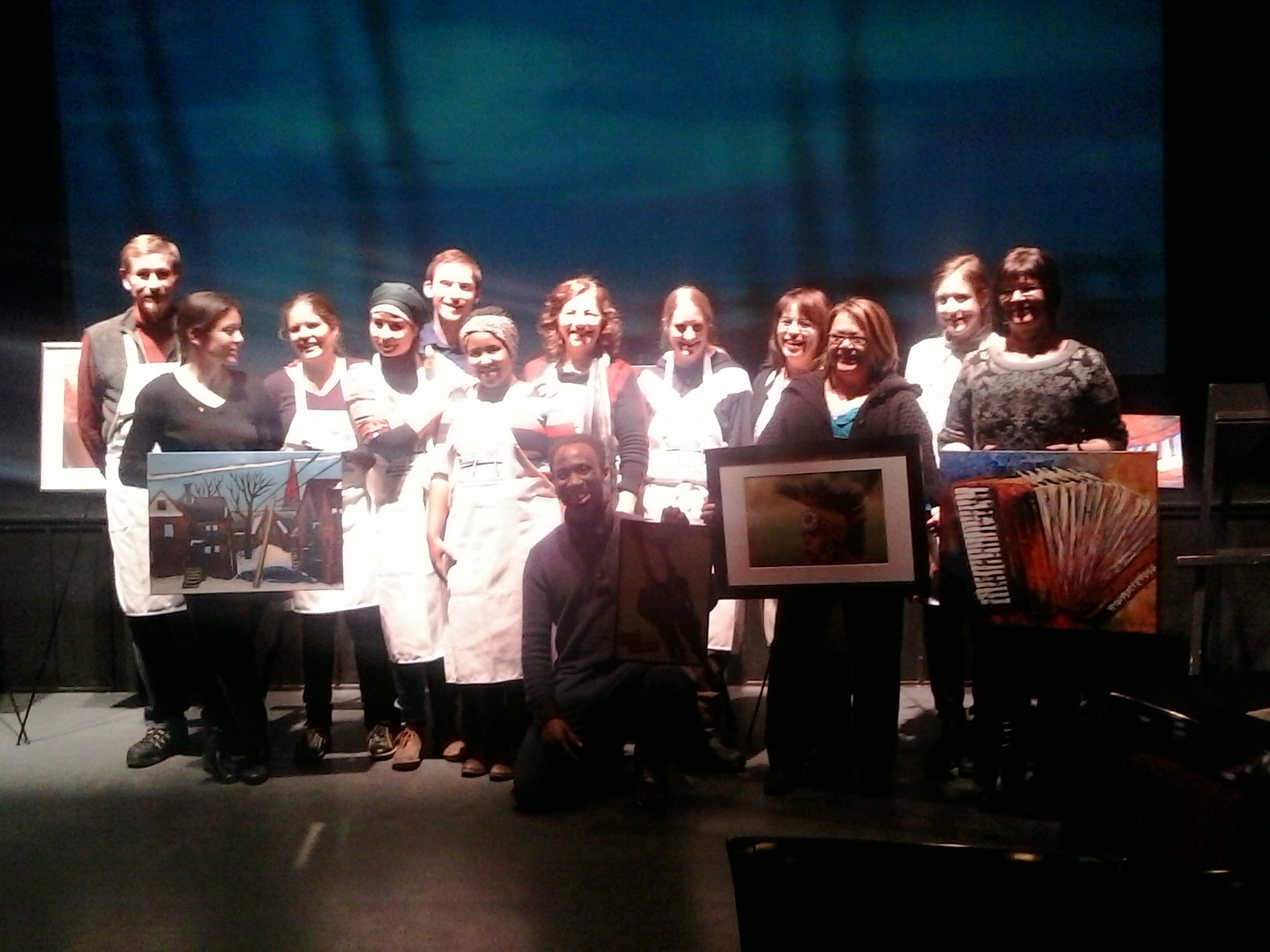
What do you get when you serve nine different kinds of soup and a variety of visual art pieces at The Mack? You get Soup’Art!

No, it’s not a joke. The Societe Saint-Thomas-D’Aquin and Confederation Centre of the Arts were completely serious when they sent out invitations to a novel art exhibit where, instead of picking at trays of traditional cocktail fare, viewers were presented with nine varieties of soup, from the traditional vegetable soup to the exotic Kenyan soup and the innovative sweet potato and coconut milk soup. It was an adventure and in itself, with the soup ladled into coffee cups that were just the right size to get a good taste of the soup without being filled so that you had no room to try the other varieties. It was soup sampling extraordinaire created by innovative and skilled soup artists.

That was not the only part of this twin-event. Along with the soup buffet was an exhibit of works by francophone artists. On display were works by Norah Pendergast, Faysal Boukari, Noella Richard, and Alma MacDougall, including paintings, photographs, graphic art, and animation. Also part of the exhibit was a traditional animal-hide shirt by self-taught Mi’kmaq artist Alma MacDougall, whose vibrant photographs of Mi’kmaq dancing in their brilliantly coloured ceremonial costumes were captivating. She photographed dancers’ heads so that they resembled colourful birds with extravagant plumage. Similarly, she captured costumed dancers in motion so that they resembled birds in some sort of ritual dance, flaunting their feathers as they twirled around.

Throughout the whole event, short films created by Faysal Boukari with students from L’École François-Buote under the ArtSmarts Program were projected onstage. Faysal is a Parisian graphic and animation artist who has chosen to stay in PEI.
He brings with him a unique and contemporary style with a certain whimsy that contributes to the mélange of artistic styles in PEI. When not working with film, Faysal’s preferred medium seems to be pen and ink.

Norah Pendergast displayed a few works that reflected island life. A French teacher in rural PEI, she is also a writer. Her paintings are reminiscent of illustrations for storybooks, likely a reflection of her background as a school teacher. Her use of primary colours in focal images in her painting draw the eye to them immediately. Her human figures are disproportionate, with the legs elongated and the heads and torsos much smaller in relation to the legs, a lengthening of proportions that is similar to Modigliani’s methods.

Noella Richard’s portrait of a man called the most attention to it, with the man’s face spilling out of the canvas, pursing his lips over likely toothless gums. Unlike her smooth portraiture were paintings of a squeeze-box and a keyboard that were done in similar style with strong red tones, rough textures, and the paint applied with a palette knife.

The variety in the artists’ styles was a great complement to the variety of soups and viewers left sated, both aesthetically and gastronomically.

2014-03-20 18.57.17

Soup’Art visual artists and soup artists

###

A Celebration of Women’s Art

0

Viewers joined artists to fill The Gallery@The Guild on the evening of March 7 to celebrate the launch of the second International Women’s Day Art Exhibit in PEI. Curated by Sandy Kowalik, the exhibit showcased the works of 53 women artists, the majority of which were paintings. Styles ranged from minimalist to modern, covering a gamut of subjects, including a bronze-cast peanut butter sandwich.

You can’t just go there and make one round of the exhibit, since there is so much to take in. I must have gone around three times, taking the works in first, from a distance, then up close to see the titles and names of artists, as well as details of each work, then from a distance again, to experience the effect each piece has on you. The pieces were grouped more or less according to style, subject, or medium, creating a kaleidoscope of colours that jumped out at you from the walls. In between the groups were sculptures in bronze, paverpol, and cornhusk, as well as a cushion, jewelry, a woven table runner, and a photo slideshow in a digital frame.

The variety of subjects, materials, styles, and colours are a testament to the diversity of the women artists who participated, indeed, a microcosm of PEI. Much more than just the artwork on exhibit, was the opportunity to meet several artists, make new friends, and participate in several interesting and stimulating discussions.

As ever, art is an expression of the artist’s being–thoughts, feelings, beliefs–past and present; it is an interpretation of life and the world as the artist sees it; it is the stimulus to creation, inasmuch as it is the creation resulting from inspiration. This exhibit is a testament to women’s art that is both inspired and inspiring. I sincerely hope that it will be something that can be done more than just once every 3 years.

*All works are on sale at $150 or less and will be on exhibit until March 15.