Writing is as technical and scientific as it is creative. Yes, even when you write creatively, there is no end to the use of scientific methods. Those of you who remember science classes will recall the scientific method requires (1) observation, (2) questioning, (3) hypothesizing, (4) experimentation, and (5) conclusion or generalization. We use the same skills when writing creatively. How? Let’s begin with observation. Writers observe the world around them, probably more so than any other people. It is from observation that writers find topics to write about. From observation, writers are able to create detailed descriptions of just about anything. How else would you describe the expressions on a person’s face who receives news of a tragedy—the widening of the eyes, the jaws dropping slightly or more, the blank expression of being unable to comprehend, and then the realization of the actuality. You watch people as they react to different situations and then ask yourself: Does the recipient accept the news, understand it, control emotional responses? Or does the recipient break down in shock, express denial, anger, depression, pain, or anguish? What emotions are expressed or shown? How are the emotions expressed? Some emotions might show similar facial expressions and body language but there are universal similarities in the way people react and the way they express emotions. The next thing you do is make certain predictions or guesses. What will the person do next? Why did the person react that way? What about the news affected the person so much? Experimentation might not be a very evident step, but when you explore the different reactions to the same situation, change certain factors—maybe where or when the news is delivered, or who receives the news, or how the news is conveyed—you could come up with several possible situations you can play around with. When you know how your characters will respond and commit that to your story, you will have come to a conclusion. The whole process of creating stories involves the exact same process in a gazillion permutations and each combination will be a different story. That’s why you’ll never run out of stories to tell.
To writers, though their pens lie still (a poem)
0
…And though their pens lie still and no new stories unfold
their stories will linger forever and be told and retold
their words will stay alive and leap from every page
forever to regale a reader, no matter what their age,
and while they’ll never leave another footstep on the ground
their words will travel far and wide and circulate around
we’ll always hear their voices whispering softly in our heads
we know they will live on and on as long as they are read.
©cindylapeña, 2016
Because we lost so many writers in 2016…
http://www.cbc.ca/books/2016/12/in-memoriam-authors-we-lost-in-2016.html
What writers do for the holidays
0If you’re like me, you’ll probably be taking advantage of the holiday season to write because it’s a nice chunk off work. Of course, since I’m completely off a regular job, I have all the time in the world to write and paint now, until I find another job. That also means I have all the time in the world to procrastinate. I could make up several excuses not to write or paint: my apartment is a mess, thanks to soon-to-be-gone neighbors; I haven’t decorated for Christmas, although considering it’s two days away, what’s the point in decorating; I’ll be cooking up a storm for Christmas dinner, although considering my apartment is a mess, there’s not much room to debone a turkey, and since all I do is end up eating the same meal every day for the rest of the week until New Year’s, when I’ll probably roast another turkey that’ll feed me until Valentine’s day, so what’s the point, really, of making a huge meal for one person; there are new castle puzzles online and completing them with 500 pieces makes a satisfying couple of hours; I could catch up on tv series and movies I’ve missed and binge watch Fibe On Demand or Netflix; I could try out my brand new Amazon Prime video and catch up on shows that aren’t on Fibe On Demand or Netflix; I could catch up on my reading, finally; I need to finish prepping for my winter courses; I need to clean up my apartment since it’s been a mess for the last three weeks, thanks again to my inconsiderate neighbors; I need to catch up on my advanced courses–and since I haven’t been signing in every week, I’ll need to start all over again just to refresh my memory; I need to resume my French lessons–and since I haven’t touched those books for the longest time, I’ll need to review everything again; I need to update a lot of things on my websites, including adding new content, etc.; I need to continue making and posting online content for sale; I need to make more new crafts for sale; and the list goes on. There are some things I can do at the same time, of course, such as my laundry and anything else; or keep the TV on as I work on my computer–it’s pretty much how I keep abreast with all the shows I want to see; then I’ll watch them all over again because I won’t remember seeing a thing or will forget the stories because I was engrossed with writing or painting. My point is, we writers are probably the most creative people when it comes to thinking of ways to put off writing. Thank goodness for a weekly newsletter that keeps me writing something. It would be just as easy to set it aside, but we don’t want to disappoint.
Whatever it is you decide to do throughout the holidays, may you have the best of the holiday season and wishing you find some time to get a bit of writing in!
Merry Christmas, Happy Holidays, and the Best of the Season to you all!
On my son Justin’s 21st birthday
4Twenty-one years ago today, my youngest son, Justin Alexander was born. It wasn’t an easy pregnancy. Miscarriage threatened when I was about 5 months pregnant along with pneumonia, for which I was confided to hospital for several days. When I was released, my doctor ordered bed rest and prohibited me from work and stress. Thankfully, my boss at the time let me do my work from home–he sent a computer and desk for me to work on and I would visit the office once a week to check on things. Following two previous classical Caesarian sections, my doctor had no choice but to operate along the previous scar to prevent further weakening of my uterus.
When Justin was finally separated from my womb, I sensed something was wrong. I heard something about his being bluish and not wanting to breathe. As after my first two babies were born, I was deeply depressed, although I never told anyone about it and never saw a mental health professional. It was only when I was living on my own for the first time after three babies and two failed marriages that I had experienced severe post-partum depression after each pregnancy. It was no better after Justin was born. He was immediately confined to the neonatal ICU within an incubator so the only way anyone could touch him was through those holes in the sides of the plexiglass panels. I don’t even remember the nurses bringing him to my room to hold or nurse after he was born. The neonatologist also determined he had high bilirubin levels, causing his skin to yellow, so he was put under a light to counter that. I was unable to get out of bed for a couple of days and only started to walk on the second day and when I finally could go to visit him, I could only watch him lying in the incubator, a skinny dark bluish yellowish waif under 6 lbs. I was discharged after the fifth day and refused to leave home, not wanting to be jolted around by a drive to the hospital just 10 minutes away. The next time I saw him, it was Christmas–that was the first time I got to really hold him in my arms for a short while. I couldn’t tell if I was happy to hold him or depressed that he was at risk. Needless to say, I couldn’t hold him long enough because I was choking back tears the whole time and he couldn’t stay out of the incubator too long, either. That was how I spent the Christmas of 95–in the hospital, watching Justin through the glass, getting to hold him a few minutes at a time, until I was just too tired and too choked up. I couldn’t get myself to visit him again. His neonatologist was a little worried as well because he didn’t seem to want to breathe on his own and needed help. She said if he didn’t breathe on day 10, they would have to intubate him. I was terrified. I could not imagine his tiny body being invaded by a tube. I could only think of my daughter when she was an infant and had to be intubated. I was more distressed than she was, I think. Ten days after Justin was born, the specialist gave him something–sodium bicarb, I think–to see if it would help him breathe, otherwise, they would need to intubate, which could cost us about 1K a day–an amount I couldn’t fathom or imagine I would ever be able to pay. Thankfully, Justin responded and by some miracle–possibly the fear of being intubated as well–decided to breathe on his own. They removed him from the incubator after a day and, two days later, he was cleared to go home in time for New Year’s Eve. He slept through all the fireworks.
Today, he is 21 and officially a man. This Christmas, I will not be able to visit him or hold him in my arms, not even for the briefest moment because eight Christmases ago, he was wrenched away from me and there was no way I could get him back.
We have not spoken since 2009 and not because it was my choice. I tried to reach out to him several times but he has avoided me. The most painful moments now are when I see him–walking, on the bus, performing–and each time, my heart sinks to the pit of my belly reminding me how empty I feel inside for the bottomless hole left inside me. The only way I get through is by trying not to think about him, how he is, how he does in university–I hear many good things about him. I wonder what he tells his girlfriend when she asks about his mom. Does she believe him? Does she even question him? I wonder what lies his father has added to the venom he fed him since I had to return to work when Justin was six until I was dragged away from my home and him just after his 13th Christmas. I try not to spend time wondering when he will realize how manipulative his father is or how he fits the bill of psychopath perfectly. I try not to hope he will one day understand what happened and realize I could no longer live in a marriage that had died a lingering death and should have been buried 10 years before it was officially ended.
How long does post-partum depression last? Or maybe, it’s still an extension of childhood depression. All my life, I must have been reacting to the depression. Granted, it has made me more creative, so should I be thankful for it? Should I blame depression for my choices? I know I chose to have Justin–I wanted to have him so much it hurt; maybe I wanted him for all the wrong reasons, because I could not get my other babies back. But I wanted him and loved him and I know I passed on a lot to him. I have been told by people who’ve met him, spoken lengthily with him, and known him, that he is so much more like me than he is or ever will be like his father and, for that, I say a silent prayer of thanks.
Today, Justin, you are a man. I can only pray that you will be your own man. I will always be your mum and I will always love you, no matter what you think; no matter what your father has made you think. I hope you always remember things I’ve taught you: to always respect others for who they are, to always treat them right, to always do your best, to always be open to new things, to think carefully before you speak, not to say anything if you can’t be nice or polite to others, to always look for answers, to always find something to keep you busy, to appreciate people, art, books, culture, to think for yourself. I hope somewhere along the way between the last time you listened to me and now, you have learned to always respect women, treat them well, and always, always remember that all relationships have two sides and both sides must share the responsibility of keeping the relationship healthy, well-balanced, and whole.
Be well, my son. May you find happiness, peace, and success in your adult life. I love you.
Short Story Appreciation
0There is creative reading as well as creative writing.
~Ralph Waldo Emerson
My Short Story Appreciation course at the Seniors College will begin in October and I’ve found nine new stories, all recent winners of a variety of writing contests from all over the world, so there will be a fair sampling of different cultural literature. One of the reasons I’m really excited about this course is having a fair-sized group of adults to share ideas with. It’s not an easy topic to bring up and if you and your friends haven’t read the same texts, there’s not much you can discuss with them. In a class, however, you all get to read the same text, dissect it, and discuss it. You get to share ideas, interpretations, and impressions and leave knowing there is a group of people you will meet again who might or might not share your thoughts and feelings, but who make reading a text more interesting because of the varied knowledge, experiences, and opinions they bring to the discussion. How fun is that?
I know one of my favourite classes was literature, no matter where in the world it came from. Is it any surprise I mastered in Literature in English? That said, there are several levels of reading and the appreciation of literature increases with each level. Different sources will mention anywhere from 2 (literal and figurative) to 5 levels. So we can cover all bases, we’ll look at the 5 levels: 1) lexical; 2) literal; 3) interpretive; 4) applied; and 5) affective.
As the word suggests, lexical comprehension involves understanding the words in a text. This is less of a problem as readers mature because of the broadening scope of their vocabulary. Improving your lexical comprehension is simple: if you don’t understand a word, consult a dictionary or thesaurus. Unfortunately, not all words mean exactly what the dictionary tells us, unless you have a comprehensive dictionary that includes idiomatic expressions and colloquial usage. That also includes localisms and dialect, as well as nuances in the use of words. Quite often, we will be able to determine the meanings of words, phrases, and expressions from the lexical milieu—or the surrounding words and paragraphs. The way the words are used, who is using them, what the speaker’s expressions are—all these can be determined from the lexical milieu or context. It can get a little more complicated: lexical meaning includes grammatical understanding. If we don’t understand the way sentences are structured, we’ll have difficulty understanding implied meanings.
Literal comprehension comes from understanding all the facts presented in the story or text. You understand it literally when you can answer the basic questions: who, what, where, and when. Sometimes, understanding at the literal level is easier than lexical comprehension because the facts don’t change; word meanings can. The interpretive level of comprehension involves answering the questions why, how, and what if. This involves reasoning, extrapolation, and prediction. When interpreting literature, we try to figure out characters’ motivations, processes, progression, and intention. Applied comprehension is when we try to see the connections between the text and existing knowledge or opinions. We decide things like right or wrong, make judgements and comparisons. When we attempt to understand the social and emotional aspects of a text, we comprehend the story on an affective level. We are able to connect motives to the development of both plot and character and, thereby, comprehend the story in its entirety, from every possible angle. It is a level of appreciation that improves with maturity and age because then, we are better able to apply the higher-order thinking skills involved in the latter 3 levels of comprehension. These higher levels of comprehension are what the Short Story Appreciation course aims to achieve.
The World is Your Macrocosm
0“A writer, I think, is someone who pays attention to the world.”
[Speech upon being awarded the Friedenspreis des Deutschen Buchhandels (Peace Prize of the German Book Trade), Frankfurt Book Fair, October 12, 2003]
~ Susan Sontag
Labour Day Weekend has passed and your kids are all back to school so you should have a little more time on your hands to write. I know I was extremely busy the past weekend, finishing a couple of art commissions, which you can see on my personal blog, Creativity Unlimited, as well as in Facebook on Art ‘n’ Words. I’m back to editing and writing and preparing for a grand reunion of my high school class, the majority of whom I haven’t seen since out silver jubilee nearly 15 years ago and others I haven’t seen since we graduated from high school. Yet, it’s a connection I look forward to renewing because it’s a connection to the past, a former life I lived that played a pivotal role in my growth and development, in molding my thoughts and values and, in many ways, my spirit. It’s not often we are given the opportunity to revisit the past, but as writers, it often helps to explore every little thing we experienced, magnify it until it is larger than life, and mold it into all the stories that make up the canon of our lives. This is why we need to pay attention to the world around us because it is the macrocosm of the world within us.
As a literature and writing teacher, I can never emphasize enough the need for keen observation. It’s no different from being a scientist. Scientists depend on observation. They watch everything, observe everything, using all their senses. Even when scientists use machines to help them speed up or slow down certain processes or observe things at levels physically impossible to humans, those machines perform only what they are made to do and scientists still have to interpret the results they glean from machines. Machines help magnify details the naked eye cannot see, sounds the human ear cannot hear, flavors and smells our taste buds and olfactory senses are not always sophisticated enough to detect, or even textures too fine for our coarse skins to feel as anything other than smooth. It is closely paying attention to the world around them that gives scientists a basis for making generalizations and coming to conclusions. They would never be able to make predictions or estimations that would be even remotely probable. The same is true for writers. Without paying close attention to the world around them, writers would never be able to accurately describe behaviour, actions, reactions, relationships, or even settings, objects, and milieus. Without all the information they acquire from observation, writers would never be able to project what they know into fictional people or fantastic worlds. Regardless of what race or make characters are, regardless of their environment, we use what we know of people and our environment to make our stories as realistic as possible. It’s the only way our stories will be understood and appreciated by our readers who are, as far as we are concerned, human, and therefore sympathetic to anything identifiably human. No matter how alien, we like to imbue our characters with human-like behaviour because that is how humans interpret the rest of the world. Anything else would be, for want of a better word, too alien.
David Bowie: Portrait in Pencil
0
David Bowie (pencil on paper, 9″x12″, private collection)
The Lorax by Dr. Seuss: A Review
0The Lorax by Dr. Seuss: A Review
By Cindy Lapeña
*Prepared for Canadian students

What happens when greed drives businesses with no concern for the environment? Theodor Seuss Geisel, better known as Dr. Seuss, has once again dealt with a sensitive and important topic in an immensely imaginative story. He is well known for stories like How the Grinch Stole Christmas and The Cat in the Hat, among others; and like his other books, this one must be read not just because it is enjoyable, but because it delivers a powerful message we need to learn while we are still very young.
Originally published in 1971 by Random House Children’s Books, Dr. Seuss’s The Lorax was a proverbial warning to care for the environment at the risk of destroying nature. It also suggests that businesses need to assume corporate responsibility for the environment by not exploiting natural resources without replacing them.
The story begins with a young boy seeking the Once-ler on a dank midnight in August in a place that is dismal with polluted air and a wind that “smells slow-and-sour when it blows.” According to legend, the Once-ler is the only one who knows about the Lorax and how it was lifted away one day.
The Once-ler was a newcomer to the place, which used to be a paradise full of green grass and Truffula Trees that bore fruits on which Brown Bar-ba-loots fed. Swomee-Swans flew about singing beautiful songs among clean clouds and Humming-Fish filled the pond.
Discovering how soft, silky, and sweet-smelling the Truffula Tree tufts were, the Once-ler decided to build a small shop to knit Thneeds from the soft tuft. As soon as he finished knitting the Thneed, the Lorax, an unusual-looking creature, appeared, demanding to know what the Once-ler had created and what he intended to do with it. Explaining that he would sell it, the Once-ler immediately sold the Thneed to a passer-by. The Once-ler was happy to sell his ridiculous product so easily and proceeded to invite all his relatives to work for him. He created a large factory to produce more Thneeds. When he wasn’t harvesting quickly enough to satisfy the production, he invented a machine to chop down trees four times as fast.
As the trees disappeared, the Bar-ba-loots lost their food source and the Lorax sent them away to find another place where they would have food. The Once-ler ignored him and continued his production because he wanted to become richer from the sale of his product. He increased production and began exporting elsewhere. Meanwhile, the factory spewed more smoke into the air so the Swomee-Swans could not sing. As a result, the Lorax sent the Swomee-Swans on their way to find cleaner air. Besides polluting the air, the factory produced waste from chemicals and dyes that were used to color the Thneeds. This waste was disposed of in the pond and soon, the Humming-Fish had to go. Each time a problem arose, the Lorax appeared to appeal to the Once-ler, speaking for the trees and the animals, which could not speak for themselves. Wanting only to get even richer, the Once-ler continued until, at last, he cut down the last tree. With no more trees or animals to protect, the Lorax lifted himself through a hole in the clouds and disappeared forever.
Left with no more trees to supply his factory, the Once-ler’s relatives abandoned him and his factory shut down. The Once-ler locked himself up in his tower-like home and never went out or spoke with anyone else except the occasional person who was willing to pay a bit to listen to his story.
In the end, the Once-ler expressed his great regret after having so much time to think about his actions, concluding that the world needed someone who really cared for it to survive. He gave the young boy charge of the last Truffula Tree seed with the advice to plant it, take good care of it and propagate more trees so maybe, one day, the Lorax would return with all his friends and make the place beautiful again.
Even if this book was written in 1971, it is still relevant today because it reminds us that we need to take care of nature. The Lorax represents all those who speak for nature and advocate conservation, while the Once-ler represents big businesses that exploit the world’s natural resources with no regard for the future. The story tells us how short-sighted big businesses are when their bottom line is profit and how that can destroy resources, which, after all, are not infinite. The young boy represents everyone else, especially young people, who need to assume responsibility for nature because without our natural resources, we will have no resources at all and an earth that is not fit to live in. It is especially meaningful today because of global warming and the greenhouse effect. We all need to understand how important taking care of the environment is for human survival. After all, without a world, there will be no humans.
*****
Our Lady of Lourdes Project
2This commission is the restoration and painting of a 4-foot high statue of Our Lady of Lourdes that was recovered from a garbage bin.
 I was determined to document the whole project with lots of photographs because I always forget to document what I do. This time, I made sure I had lots of photographs, especially since this would be quite a challenge. I took several photographs from different angles. The photo on the left is from the rear, right.
T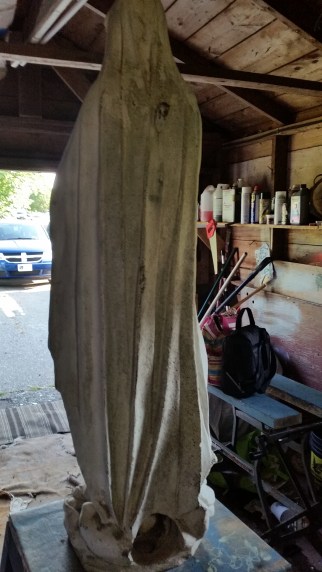 he next photo to the right show the back, which was rough, dirty, and had several chips and chunks broken from the cape. A rusty pipe also stuck out from the back, most likely an attachment to a fountain. The pipe had to be sawed off, which also took off a tiny chunk more of concrete, but it didn’t make anything worse than it already was.
The photo below shows the left side of the statue, w here you can see a large crack under the left arm. The photo to the right show the full front.

This close-up of the face shows chips on the nose, the corroded front, and hollowed-out eyeballs.
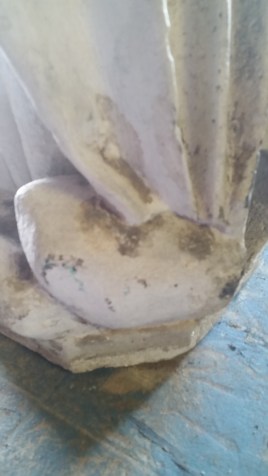
The photo on the right shows how corroded the base is. This is from the left side of the statue.
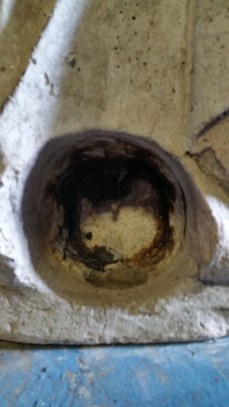
The rear bottom of the statue had a hole where the pipe exited; there were bits of rusted metal inside, most of which I was able to pry away. This is worrisome because there’s no telling how much mold and mildew was inside the statue itself.
Panning out a little in the next photo, you can see the chipped cape and pockmarks, most probably from mold as well as pieces of granite falling out from the concrete. 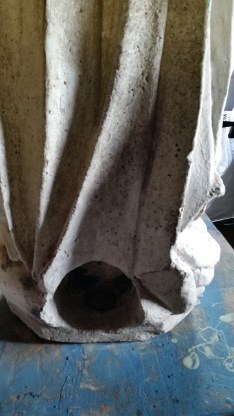
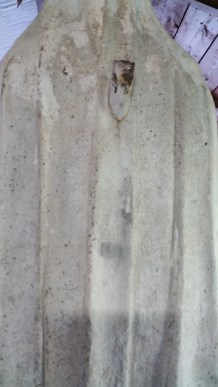
This close-up of the back shows more cracks across the shoulders and where the pipe came out–about 2 inches of it protruding from the back. There are also cracks across the lower part and several chips out of the folds of the cape, as seen below as well.

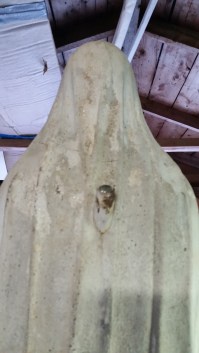
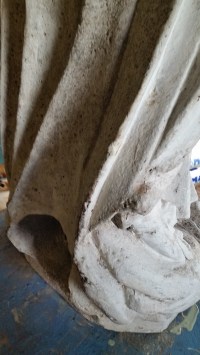
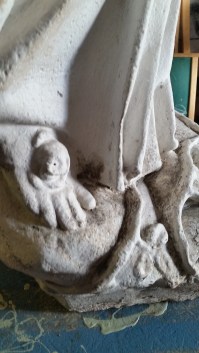
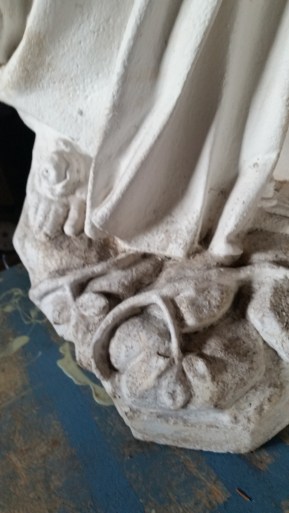
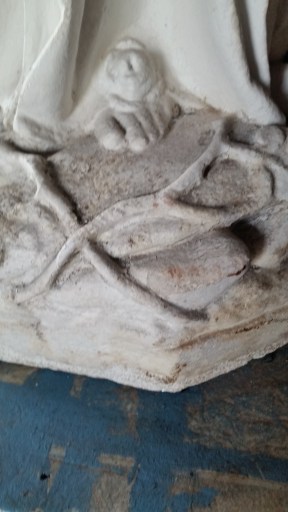
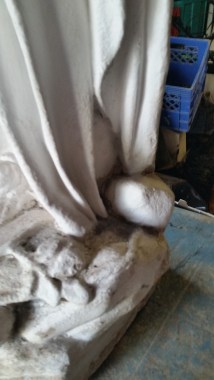

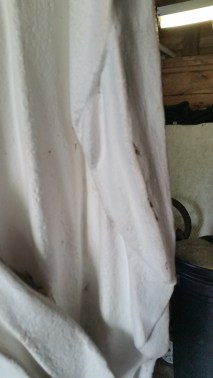

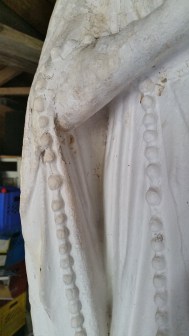
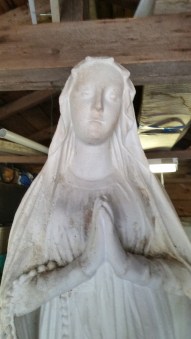
August 16, 2016: This is the statue after it had been scrubbed and hosed down. In its original state, it was cracked, moldy, and had layers of old paint. The first phase would involve removing all the loose paint and cleaning out chips and cracks, and smoothening the surface so there would be as little difference as possible between the original surface and the surface where the old paint would not come off.
August 21, 2016: The next stage involved patching up the statue: repairing chips, filling in holes and cracks, and smoothing the roughest parts. This included a little “nose job” as well! I preferred to use my fingers to fill in the cracks with a nice spackle that promised not to expand or shrink. This was important because the statue is going to be put outdoors and expanding or shrinking of the filler could compromise the statue and create worse problems in the future. I’m hoping the product is true to its claim! After the cracks and holes were filled, I applied a sealant to make sure no moisture would get into the really fine cracks and holes left from concrete and granite separation.


August 28, 2016: Finally, the actual painting work could begin! I started with a good primer.
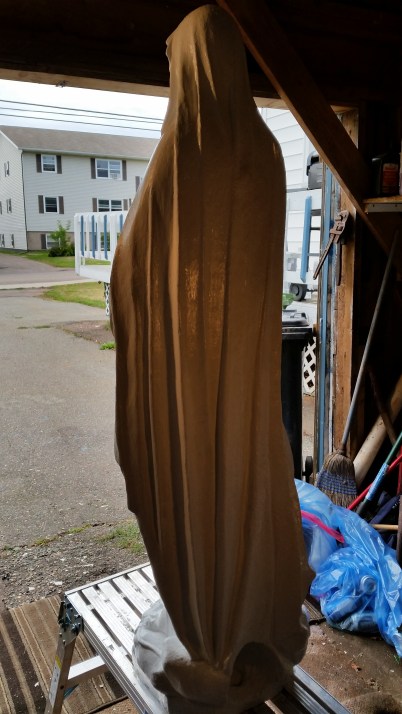
After the primer, I painted the whole statue white, then applied the base skin color to the face, neck hands, and feet.


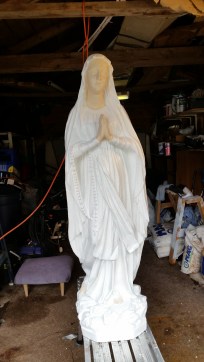
The next biggest swath of color was the blue cape and the sash. I selected a lovely sky blue color for this. I deepened the shadows in the folds of the cape with a bit of purple.

Then, I decided to work on the base next, painting in the roses on the feet, leaves, branches, and the rock.
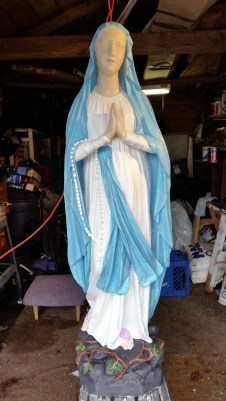

The final touch for the day was a tinge of pink on the cheeks and shaping the lips with the same tinge.

I planned to work the whole weekend, but the weather was damp and rainy, so I never got to return to the statue that weekend. I finally got back to it the next weekend, which, thankfully, had lovely sunny weather.
September 3, 2016: I worked on details. I started with the face, working on the mouth because that would be the easiest. Then I worked on the eyes, starting with an outline and layering on the white, the pink flesh inside and around the whites, a brown cornea, black for the iris, then the most delicate lines on the cornea with black, white light spots, eyelashes, and the eyebrows. I also added shadows to the face, neck, hands, and feet, then did the fingernails and toenails as well. I used brown on the rosary to simulate wooden beads. Finally, I applied a gold trim on the veil and cape as well as a touch of gold thread/trim on her collar and cuffs. I even touched the cornea with a few very fine gold lines to make them look more real. At the end of the day, I sprayed the whole statue with a layer of non-yellowing transparent matte overcoat.


September 4, 2016: I returned to the statue for finishing touches, retouching spots where there was white on blue or blue on white, brown on flesh, touching up the shadows, cleaning up edges of lines, before the final couple more layers of finish. I wish there was more light from the back so you could see details of the cape, especially where there were chips and chunks gone from it.


The statue will go to St. Francis Church in Cornwall, Prince Edward Island, where I hope they will take good care of her. I have given instructions for them to apply a couple of coats of spray-on finish once a year to preserve the colors.
It’s so satisfying to complete a project and see it turn out so well! I’m always sorry to finally finish a job, but also glad that each commission I complete opens up doors to more similarly satisfying jobs. It’s work I would not mind doing for the rest of my life! The biggest challenge with this project was the restoration first, then working with the rough concrete surface. And then the worries about how the face would turn out and if I could do justice to the subject.I could tell it had a lovely face from the start and I was excited to see what I could do with such a damaged statue. I’m really happy with the finished work.
###
On Writing: Good vs Good
0The best stories don’t come from “good vs. bad” but “good vs. good.”
~ Leo Tolstoy
One problem writers have is determining what thematic conflict to use in a story. Stories can universally be classified according to theme, the most common of which is good vs. bad. Since the inception of literature as an oral form, themes revolved around the hero, who eventually epitomized things a culture considered good, and the enemy or villain, who eventually represented what was bad or evil in a culture. Hence, the clansman who returned with a bear or a lion was the hero who brought home food to the clan while defeating the predatory, monstrous, man-killing beast, which came to represent evil. The hero could be the warrior who defeated the leader of an aggressive tribe or the mother who saved her child from the threatening rapids of a swollen river. It’s not difficult to see how attributes of good and evil can be assigned to the character elements involved. These characteristics were transferred to different characters, including the popular animal characters in fables. Fast forward to contemporary literature of the 21st century. As early as the latter half of the 20th century, the term “hero” was replaced with “protagonist” and the “enemy” or “villain” was called the “antagonist”. This most likely had to do with the influence of a growing political correctness that demanded a greater sensitivity to the use of derogatory terms. It suited literature well because, quite often, the antagonist could not be defined because of the very familiar man vs nature conflict. Also, because the enemy might not be nature but also might not be human, what used to be man vs beast soon became man vs other, the “other” being anything from beast to monster to alien to technology, e.g., machines, robots, and computers. The rise of anti-heroes and reluctant heroes as very real characters also made it easier for literature to adopt the “protagonist” label—the central character in the story, around whom the plot develops. The concept of the anti-hero fits well with the idea that not all struggles or conflicts are between good and evil. This was a simplistic way of looking at the world proposed by religion: anyone who followed the church and its rules was good, anyone who did not was bad; by extension, any character who practiced the values espoused by religion was good. As such, characters were written with characteristics of what was considered good and righteous, or strove to achieve those traits. The moralistic tale Pilgrim’s Progress was just that: a Christian’s journey through temptations and tests that strengthen his Christian faith and values. Realistic literature later on dispensed with the notion that characters were either good or bad, instead revealing the inner workings of the human psyche. In truth, good people sometimes do bad things and bad people also do good things. That’s the reality: people are complex. So when complex people are portrayed facing complex situations that mimic real life and encounter other characters who are just as complex, literature suddenly becomes much more interesting and exciting. I still believe people are basically good. Those who are truly evil have mental and psychological aberrations as a result of some faulty wiring in their synapses that prevent them from deriving satisfaction of pleasure from positive experiences. The basically good ones are those who face reality, encounter other good people and don’t always agree in varying degrees. It’s those little conflicts from day to day heightened to literary proportions that give writers a bottomless reservoir to draw from.
 Cindy Lapeña: Creativity Unlimited